

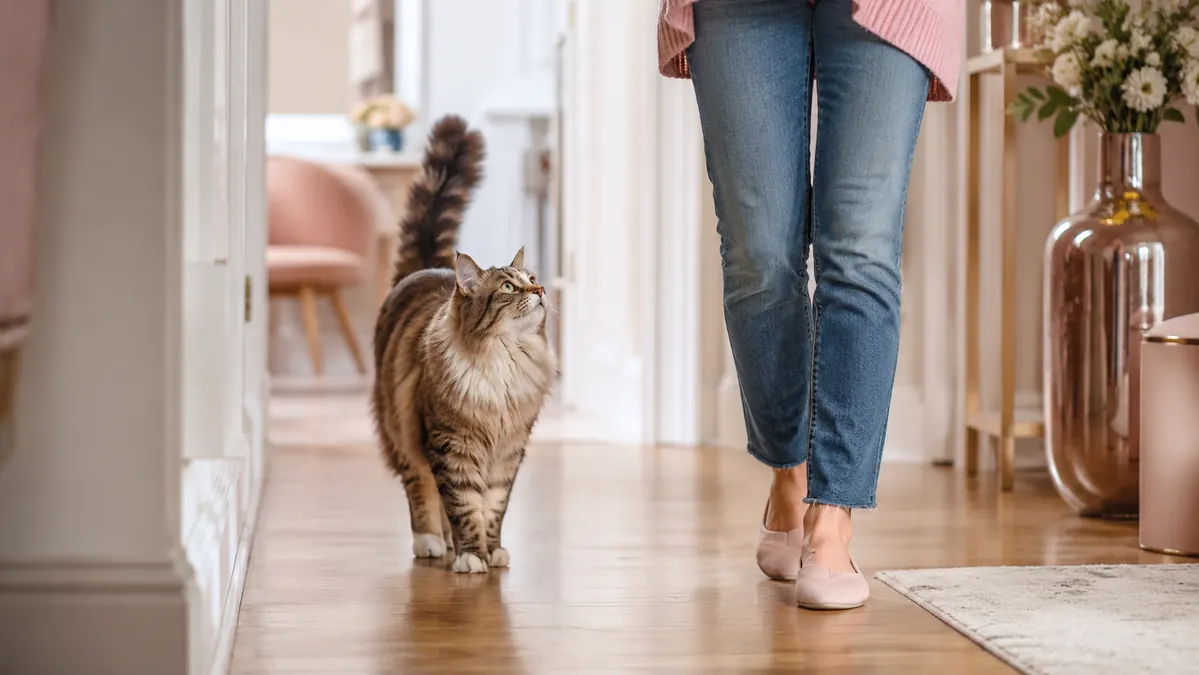
You stand up.
Your cat stands up.
You walk into the kitchen. Your cat arrives in the kitchen.
You go to the bathroom believing, somewhat optimistically, that this might be a private activity.
Your cat would like to discuss your misunderstanding of household policy.
Cats have a reputation for being independent, but plenty of them follow their people from room to room. Usually, this behavior is perfectly normal and comes down to some combination of attachment, curiosity, routine, food, and the simple fact that you are one of the more interesting things happening in the house.
If you’ve ever wondered, “Why does my cat follow me everywhere?” the answer is usually some combination of affection, curiosity, routine, food, attention, and plain old feline supervision.
Here are eight reasons your cat may have appointed themselves your full-time supervisor.
1. Your Cat Actually Likes You
This may be inconvenient for your reputation as an independent adult, but your cat may simply enjoy being around you.
Cats form social bonds with the people they live with. Some show affection by sitting in laps or demanding physical attention. Others are subtler: they stay in the same room, sleep nearby, greet you when you come home, or quietly relocate every time you do.
Following can be part of that same social behavior. Your cat may not necessarily want to be touched, picked up, or entertained. They may simply prefer knowing where you are.
In other words: management is not hovering. Management is maintaining appropriate oversight.
2. You Are Historically Associated With Food
Cats are excellent at learning patterns, especially when those patterns involve dinner.
If you are the person who fills the bowl, opens the treat cabinet, prepares wet food, or occasionally produces a suspiciously interesting snack, your movements may carry commercial significance.
Walking toward the kitchen can therefore trigger immediate supervision. So can standing up near the usual feeding time, opening a cabinet, touching a grocery bag, or making any sound remotely similar to a treat container.
Your cat has learned that certain human movements have an excellent chance of producing snacks.
You move. They assess whether the movement has treat potential.
3. They Want Your Attention
Sometimes the explanation is exactly as obvious as it looks: your cat wants something from you.
That might mean petting, play, conversation, access to a favorite spot, or simply acknowledgment that they have entered the room and should now be regarded appropriately.
Cats learn which behaviors get a response. If following you results in attention — even if that attention is you saying, “Why are you following me?” — the behavior can become worth repeating.
Some cats are also much more socially demanding than their reputation suggests. They may want interaction several times throughout the day…
You thought you were being observed. You may actually be receiving a service request.
4. They Need to Know What You’re Doing
Cats are curious, and your movements create information.
You stand up. A door may open. A cabinet may reveal something interesting. A laundry basket may become available. An otherwise inaccessible room may suddenly require inspection.
Following you lets your cat monitor these developments in real time instead of finding out later that something happened without proper feline oversight.
This is especially common with cats who like being involved in household activity but do not necessarily want constant physical attention.
The room is not necessarily interesting. Your audacity is.
5. They’re Bored
If your cat does not have enough stimulation, you may become the most interesting thing available.
Indoor cats benefit from opportunities to stalk, chase, climb, scratch, investigate, and solve small problems. When those outlets are limited, following a person around the house can become entertainment.
You may notice other signs too, such as persistent attention-seeking, excessive meowing, nighttime activity, ambushing ankles, or repeatedly trying to start interaction.
More structured play, rotating toys, window access, climbing space, food puzzles, and short hunting-style play sessions can give your cat more to do besides supervising you.
If the enrichment program is weak, management may begin auditing personnel.
6. Following You Has Become Part of the Routine
Cats are creatures of habit, and they are very good at noticing yours.
If you get up at the same time, make coffee in the same place, work from the same chair, or follow a predictable evening routine, your cat may simply have built themselves into the schedule.
Over time, following you can become less about wanting something specific and more about participating in the sequence of events they expect to happen.
That is why some cats seem to appear before you have even decided what you are doing next. They have watched this episode before.
You call it a routine. Your cat calls it a documented operating procedure.
7. Being Near You Feels Safe
Your presence can also function as a source of security.
Cats may stay close to people they trust when something feels unfamiliar, noisy, or slightly off. Visitors, construction, storms, a new pet, travel, rearranged furniture, or even changes in household routine can make a familiar person more appealing.
Some cats simply feel more relaxed when they know where their person is. Following can be one way of maintaining that sense of predictability.
This does not always look obviously anxious. A cat may appear calm while still choosing to stay unusually close.
Apparently, you have been designated a portable safe zone.
8. Something Has Changed
If your cat has always followed you, the behavior is usually just part of who they are. A sudden increase in clinginess deserves a little more attention.
Cats can become more attached when they are stressed, uncomfortable, aging, or not feeling well. Changes in appetite, drinking, litter-box habits, sleep, vocalization, mobility, grooming, or general behavior matter more than following alone.
If the behavior is new, intense, or accompanied by other changes, it is worth checking in with your veterinarian rather than assuming your cat has simply become more affectionate.
Management may be overbearing. Management should still receive appropriate medical care.
Does Following You Mean Your Cat Has Separation Anxiety?
Not necessarily. A cat who follows you around the house is not automatically experiencing separation anxiety.
The more important question is what happens when you are not there. A cat who simply enjoys following you may settle down, sleep, eat, play, or go about their normal routine once you leave.
Separation-related distress is more concerning when your absence is associated with significant behavioral changes, such as persistent vocalization, inappropriate urination or defecation, destructive behavior, excessive grooming, loss of appetite, or obvious agitation around departures.
If your cat becomes distressed when left alone — particularly if the behavior is new or severe — talk with your veterinarian. Medical issues can contribute to behavioral changes, and a veterinarian can help determine whether anxiety or something else may be involved.
Following you to the bathroom is intrusive. Panicking when you leave the house is a different issue.
Should You Stop Your Cat From Following You?
Usually, no.
If your cat is relaxed, healthy, and simply likes accompanying you around the house, there is generally no reason to discourage the behavior.
What you can do is make sure following you is not their only source of stimulation. Give them appropriate places to climb, scratch, watch the world, hide, play, and investigate independently.
If your cat constantly demands interaction, you can also avoid rewarding every single follow with food or attention. Predictable play sessions and routines can help without turning every trip to the kitchen into an event.
The goal is not to make your cat less attached to you. It is to make sure they are comfortable both with you and without your constant participation.
You are allowed to have boundaries. Whether those boundaries will be formally recognized remains under review.
The CatSassy Verdict
So why does your cat follow you everywhere? Most of the time, it comes down to a fairly ordinary mix of affection, curiosity, routine, food, attention, and the fact that your movements are apparently considered relevant household information.
If your cat has always followed you, seems relaxed, and is otherwise behaving normally, there is usually nothing to fix.
Pay more attention when the behavior is new, suddenly much more intense, or accompanied by other changes in eating, drinking, litter-box habits, grooming, mobility, sleep, or temperament. That is when a conversation with your veterinarian makes sense.
Otherwise, congratulations. You have been assigned a supervisor. Attendance appears mandatory.
Frequently Asked Questions
Why does my cat follow me to the bathroom?
Bathrooms are small, predictable, and full of things cats find interesting: running water, closed doors, rugs, routines, and a human who is temporarily stationary.
Your cat may also have learned that bathroom trips are reliable opportunities for attention or access to a room they are sometimes excluded from.
Privacy is a human concept. Your cat has declined to adopt it.
Why does my cat follow me but not want to be petted?
Following and physical affection are not the same thing. Some cats prefer proximity without much touching.
They may want to know where you are, sit nearby, or participate in whatever is happening while still maintaining control over when physical contact occurs.
Presence requested. Hands optional.
Why has my cat suddenly started following me everywhere?
A sudden behavior change deserves more attention than a long-standing habit.
Stress, changes in the home, aging, discomfort, or illness can all affect how closely a cat stays near you. Look for other changes in appetite, drinking, litter-box habits, sleep, grooming, mobility, vocalization, or temperament.
If the clinginess is new, persistent, or accompanied by other symptoms, contact your veterinarian.
A new management policy deserves investigation.
Sources & Further Reading
- VCA Animal Hospitals — Preventing Separation Distress During and After the COVID-19 Pandemic. Useful for separation-related distress signs, including vocalization, house soiling, destructive behavior, reduced eating and over-grooming, as well as the importance of routine and mental stimulation. VCA Source
- Cats Protection — Our Guide to Indoor Cats. Supports the enrichment recommendations around puzzle feeders, interactive toys, climbing opportunities and exercise. Cats Protection – Indoor Guide Source
- Cats Protection — Cats and Play. Notes that boredom and a lack of appropriate play opportunities can contribute to redirected play behavior, and recommends veterinary evaluation when new behavior appears suddenly in an adult cat. Cats Protection – Cats and Play Source
- Cornell Feline Health Center — The Special Needs of the Senior Cat. Cornell specifically advises that changes in a cat’s behavior or physical condition should prompt veterinary attention rather than simply being attributed to age. Cornell Feline Health Center – Source